

Social innovation creates new or improved ways to address community needs, with lasting value depending on whether people affected by a problem help shape the solution. For local leaders, organizations, and residents, the practical test is not whether an idea sounds novel, but whether it improves human outcomes fairly and can endure without shifting hidden costs onto the community.
Key points for creating change that lasts
- Start with a defined need and listen to people who experience it directly.
- Share decision-making, resources, and responsibility instead of treating residents as an audience.
- Test a small, workable version before expanding it.
- Measure changes in people’s lives, not only activity, reach, or money spent.
- Plan for maintenance, accountability, and community control from the beginning.
What counts as social innovation?
Social innovation is a new or meaningfully improved solution to a social need, designed to create public or community value. It may take the form of a service, a local practice, a partnership, or a change to policy and funding. A new idea is not automatically an innovation with lasting value: its effects and distribution matter.
A widely cited definition from the Stanford Social Innovation Review emphasizes solutions that improve on existing approaches and create value for society. That lens helps distinguish a promising intervention from novelty for its own sake. It also invites a harder question: who actually gains, and who carries the cost?
Unlike a one-time donation or temporary campaign, a durable approach changes how a need is met. Charity can be essential in an emergency, but innovation aims to improve the practices, relationships, or systems that shape the issue over time. The two can complement each other, provided short-term relief does not become a substitute for addressing persistent barriers.
Four practical forms of community innovation
Community change can emerge through different mechanisms, and one initiative may combine several. These categories are a practical guide rather than a fixed taxonomy.
| Form | What changes | Illustrative example |
|---|---|---|
| Service | How people access support | A mobile advice service scheduled with residents around transport and work patterns |
| Community practice | How people share knowledge or resources | A neighborhood food-sharing network with agreed roles |
| Partnership | How organizations coordinate | Schools, health providers, and residents plan a shared referral process |
| System or policy | How rules, funding, or authority work | A public fund gives residents a formal role in setting local priorities |
The useful distinction is not whether an idea is digital, entrepreneurial, or nonprofit. It is whether the approach meets a real need, improves on available options, and distributes benefits responsibly. For example, a technology platform may help coordinate care, but it can also exclude people without reliable internet unless offline access is designed in.
What can a community-led solution look like?
Imagine residents and local partners turning an underused lot into a shared garden and food-sharing point. People living nearby help decide what to grow, what facilities are needed, who can use the space, and how ongoing work will be shared. The intervention is not simply a garden; it is the set of relationships and decisions that make the space useful and cared for.
A thoughtful pilot might begin with a few raised beds and a schedule for open planning sessions. Residents can then assess whether the space meets local priorities, such as access to fresh produce, social connection, or a welcoming place for older neighbors. These are intended outcomes to check, not results to assume.
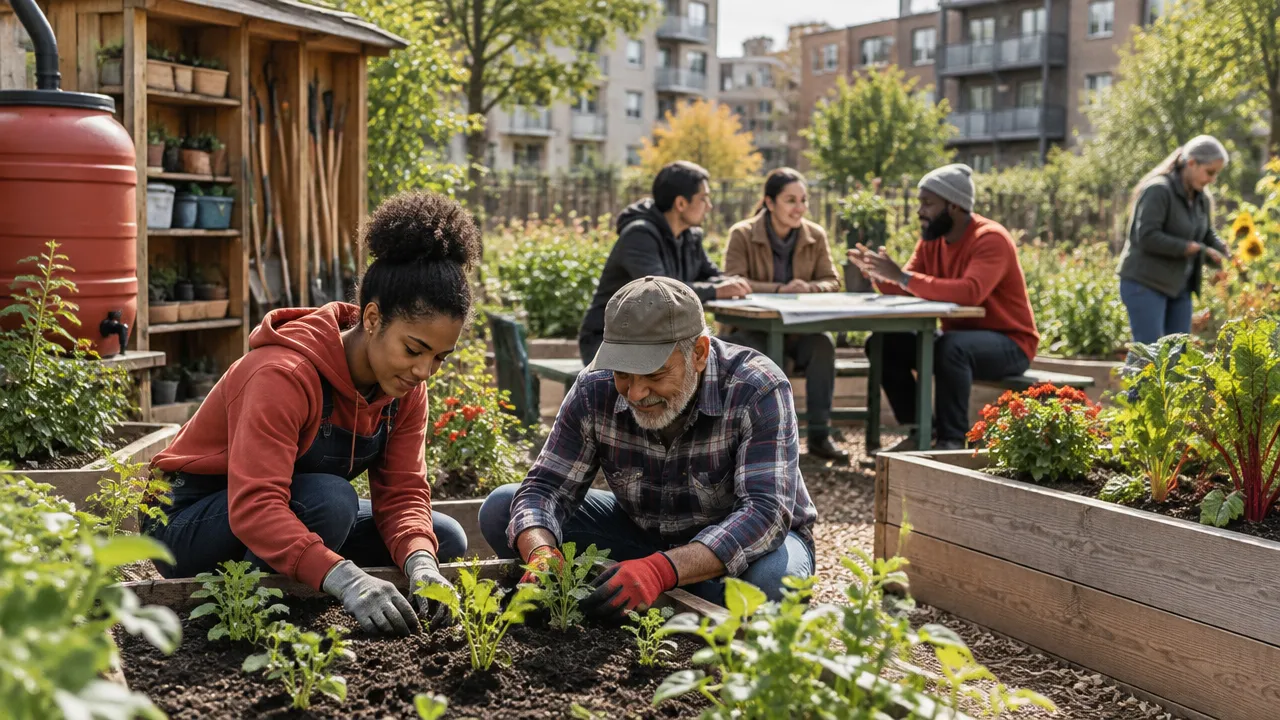
For the work to be genuinely shared, residents need influence over decisions and practical support to participate. This includes clear responsibilities, accessible meeting times, and an honest process for resolving disagreements. Approaches to shared decision-making can help groups make that influence visible rather than symbolic.
How can communities move from an idea to lasting change?
Lasting initiatives are built through a learning cycle, not a launch event. A small test gives the people involved a chance to discover what works before committing more resources or expanding to other settings.
- Listen and define: Describe the need with residents, including how existing services fall short.
- Co-design: Agree on a modest intervention, who decides, and what support participation requires.
- Test and adapt: Run a limited pilot, invite candid feedback, and change the design when evidence points to problems.
- Resource and govern: Identify who maintains the work, what it costs, and how the community can hold partners accountable.
- Review before scaling: Check whether outcomes are equitable and repeatable in the next context.
Expansion should follow evidence, not enthusiasm alone. A successful pilot may depend on a trusted local coordinator or a specific building, so copying it elsewhere without those conditions can weaken results. Leaders who make space for dissent and correction are more likely to notice harm before it becomes embedded.
Measure human outcomes, not just activity
Counting meetings, participants, or services delivered can show whether work is happening, but it cannot prove that life improved. A balanced review combines activity measures with outcomes people experience and checks whether benefits reach groups who were previously overlooked.
- Access: Can intended participants use the service without unreasonable cost, travel, language, or technology barriers?
- Agency: Do residents influence decisions, or are they only consulted after plans are set?
- Well-being: Do participants report a meaningful improvement related to the original need?
- Durability: Does the improvement continue when a grant, organizer, or pilot period ends?
- Fairness: Are benefits shared, and are burdens or risks concentrated on particular people?
Agree on a starting point and review questions with community members before collecting information. Human impact measures can complement financial and operational indicators by asking what the numbers mean for people. Ethical purchasing and local partnerships can also shape who benefits from spending, as explored through ethical local procurement.
When does a well-meant initiative cause harm?
Good intentions do not guarantee fair outcomes. A project can reproduce the very power imbalance it aims to address if outside organizations define the problem, collect residents’ stories without giving them influence, or withdraw support without a transition plan.
Before acting, ask whose knowledge counts, who controls the budget, what information is being collected, and how people can raise concerns safely. Watch for participation that is symbolic, unpaid work placed on already stretched residents, or success measures that reward visibility rather than benefit. Practical safeguards for avoiding tokenism in impact work help turn consultation into accountable partnership.
Social innovation is most credible when it can be corrected. Publish what did not work, return findings to participants, and let the community influence whether the project should change, continue, or stop. That discipline treats human impact as part of value, not as a pleasant side effect.
Frequently asked questions
What is social innovation?
Social innovation is a new or meaningfully improved way to address a social need, with benefits intended to reach the wider community. It can be a service, practice, partnership, or policy. Novelty alone is not enough: the approach should respond to a real need and be assessed for who benefits and who may be harmed.
What is one example of social innovation?
One example is turning an unused neighborhood lot into a community garden, food-sharing point, and gathering space. Residents help choose the design, establish shared responsibilities, and decide how to use the harvest. The innovation is not just the garden; it is the community-led arrangement that makes the space useful and maintainable.
What are the main types of social innovation?
Useful categories include new services, community-led practices, cross-sector partnerships, and changes to policies or funding systems. These are practical ways to organize examples, not a universal official taxonomy. A single initiative may combine several, such as a local service developed by residents and funded through a public partnership.
What impacts can social innovation have?
Its impact can include improved access to services, stronger community relationships, greater local agency, or changes to the systems that create a problem. Outcomes depend on context and implementation. Track who benefits, whether benefits last, and whether costs or unintended harms fall disproportionately on particular groups.
How can communities make social innovation last?
Communities can improve the chance of lasting change by sharing decision-making from the start, testing a small version, and agreeing how results will be reviewed. A durable plan also names who will maintain the work, where resources will come from, and how residents can revise or end an approach that is not helping.